The Chain Reaction Framework™: Operational Pressure & Sustainable Growth
The Chain Reaction Framework™: Operational Pressure & Sustainable Growth

Most businesses treat symptoms. The Chain Reaction Framework™ uncovers the cause.
The Chain Reaction Framework™ is a proprietary five-stage methodology for understanding how operational pressure moves through a growing business, where capacity is being lost, and where hidden dependencies are creating reliance on the owner or key people.

Why Was The Chain Reaction Framework™ Created?
The Chain Reaction Framework™ grew from seeing the same pattern repeatedly across businesses and functions.
The problem presenting itself was rarely the whole problem. A finance issue could begin in operations. A people problem could expose an unclear process. A system problem could reveal weak ownership. A decision made in one part of the business could create pressure somewhere completely different.
As businesses grew, another pattern became increasingly visible: capable owners and good people compensated. They carried knowledge, made decisions, worked around weak processes, and filled gaps in the operating structure.
The Chain Reaction Framework™ was created to follow those connections.
Rather than treating each symptom separately, it provides a structured way to understand how pressure moves through the business, where people are carrying what the structure should, and what needs to be strengthened to support sustainable growth.
What kept the business moving in the short term could eventually become a source of dependency and lost capacity.
What Most Businesses Misunderstand About Operational Pressure
Most businesses assume operational pressure is being created where the problem appears.
Poor communication looks like a communication problem. Slow decisions look like a leadership problem. Missed deadlines look like a process problem. An overloaded manager looks like a capacity problem.
But businesses don't operate as a collection of isolated parts. People, processes, information, and decisions are connected. Pressure created in one area can travel through the business and surface somewhere completely different.
That's why fixing the visible problem doesn't always stop it returning. The issue making the most noise may not be where the pressure began.
The Chain Reaction Framework™ follows those connections before deciding what needs to change.
Why Was The Chain Reaction Framework™ Created?
The Chain Reaction Framework™ grew from seeing the same pattern repeatedly across businesses and functions.
The problem presenting itself was rarely the whole problem. A finance issue could begin in operations. A people problem could expose an unclear process. A system problem could reveal weak ownership. A decision made in one part of the business could create pressure somewhere completely different.
As businesses grew, another pattern became increasingly visible: capable owners and good people compensated. They carried knowledge, made decisions, worked around weak processes, and filled gaps in the operating structure.
The Chain Reaction Framework™ was created to follow those connections.
Rather than treating each symptom separately, it provides a structured way to understand how pressure moves through the business, where people are carrying what the structure should, and what needs to be strengthened to support sustainable growth.
What kept the business moving in the short term could eventually become a source of dependency and lost capacity.
What Most Businesses Misunderstand About Operational Pressure
Most businesses assume operational pressure is being created where the problem appears.
Poor communication looks like a communication problem. Slow decisions look like a leadership problem. Missed deadlines look like a process problem. An overloaded manager looks like a capacity problem.
But businesses don't operate as a collection of isolated parts. People, processes, information, and decisions are connected. Pressure created in one area can travel through the business and surface somewhere completely different.
That's why fixing the visible problem doesn't always stop it returning. The issue making the most noise may not be where the pressure began.
The Chain Reaction Framework™ follows those connections before deciding what needs to change.
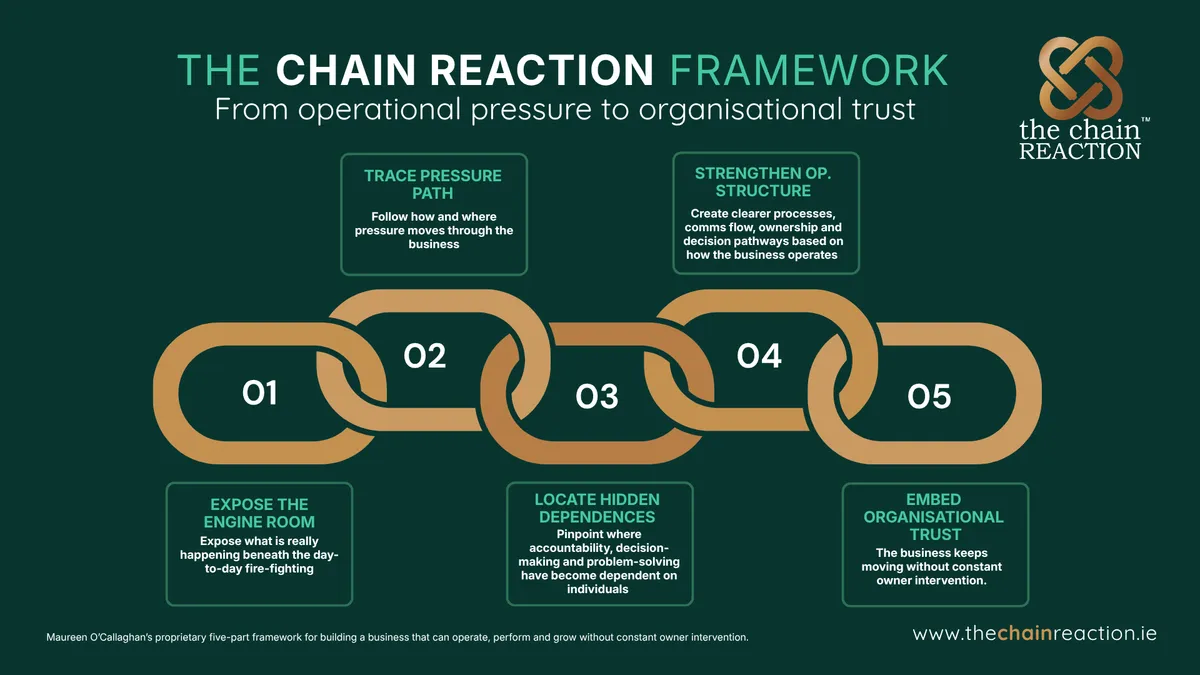
THE 5 STAGES OF OPERATIONAL FLOW
Expose the Engine Room
What it does: Reveals what is really happening beneath the day-to-day firefighting. It looks beyond individual incidents to see how work is actually getting done, where operational friction is showing up, and where people are compensating to keep things moving.
Why it matters: The visible problem rarely tells the whole story. Understanding the reality of how the business operates gives us a stronger starting point than assumptions about what should be happening.
TRACE THE PRESSURE PATH
What it does: Follows how operational pressure moves through the business. It traces the connections between people, processes, communication, and decision-making to see where pressure in one area is creating consequences somewhere else.
Why it matters: Problems that appear unrelated can be part of the same chain reaction. Following those connections makes it possible to see where capacity is being lost and why fixing one isolated issue may not stop the problem resurfacing.
REVEAL THE HIDDEN DEPENDENCIES
What it does: Identifies where knowledge, accountability, decision-making, and problem-solving have become concentrated in the owner or a small number of key people rather than being supported by the operating structure.
Why it matters: Capable people compensating for gaps can keep a business moving for years, but as the business grows that reliance can create bottlenecks, overload key people, and limit capacity. The issue is not the people; it is what the business has come to depend on them to carry.
Strengthen THE OPERATING STRUCTURE
What it does: Uses what the earlier stages reveal to strengthen the relevant systems, processes, ownership, communication, and decision pathways so more of the business is carried by its operating structure rather than individual effort.
Why it matters: Sustainable growth requires the structure of the business to grow alongside the business itself. Strengthening how work, information, ownership, and decisions move through the organisation reduces the need for people to continually compensate for gaps.
EMBED Organisational TRUST
What it does: Embeds clearer ownership, decision-making, and ways of working so people know what good looks like, who owns what, how decisions are made, and what happens next. The focus is on making the strengthened operating structure reliable in day-to-day practice.
Why it matters: Organisational trust is created when people can rely on the way the business operates rather than depending on particular individuals to step in, compensate, or hold everything together. This allows the business to keep moving without constant owner intervention.
How The Framework Operates Across Our Engagements
The Diagnostic Entry: The Chain Reaction™ Pressure Map
The Chain Reaction™ Pressure Map is the first practical application of the framework. During the diagnostic, I use The Chain Reaction Framework™ to look beyond the problems presenting on the surface and follow how pressure is moving through the business. We examine the connections across people, processes, communication, and decision-making to deliver a valuable, evidence-based diagnostic in its own right.
The Bespoke Pathway: The Chain Reaction™ Partnership
The Chain Reaction Framework™ provides the structure behind the six-month Partnership, but it is not applied as a rigid five-step programme. The Pressure Map establishes the starting priorities, and from there, the framework guides how we investigate those priorities, follow connections, identify hidden dependencies, and build a resilient operating structure.
Ready to See What The Framework Reveals in Your Business?
Begin with The Chain Reaction™ Pressure Map to understand where operational pressure is coming from, where capacity is being lost, and what needs attention first.

The Chain Reaction™ works with owner-led manufacturing businesses to identify where pressure, complexity and operational gaps are making the business harder to run. Through practical, whole-business consultancy, we help business owners understand what is really happening across finance, operations, systems, people and processes, and put the right structure in place to support sustainable growth.
Pages
Contact Info

Address
Registered address:
Portlaoise, Co Laois, Ireland

Call Us
+353 (0) 8617 42147

© 2026 Clarity Queen Limited. All Rights Reserved. Trading as The Chain Reaction™. Company No. 821163. Registered in Ireland.
This website was designed and built by The Brand Visioneer